Although banned or heavily regulated for decades, some persistent organic pollutants continue to linger in the marine environment. PCBs and DDT are among them: these chemicals can persist for long periods, accumulate in living organisms and move through marine food webs.
The Mediterranean is particularly vulnerable to their persistence. Its semi-enclosed nature, high population density along the coastline, and the intensity of industrial, agricultural and tourism activities all contribute to the pressures affecting its marine ecosystems.
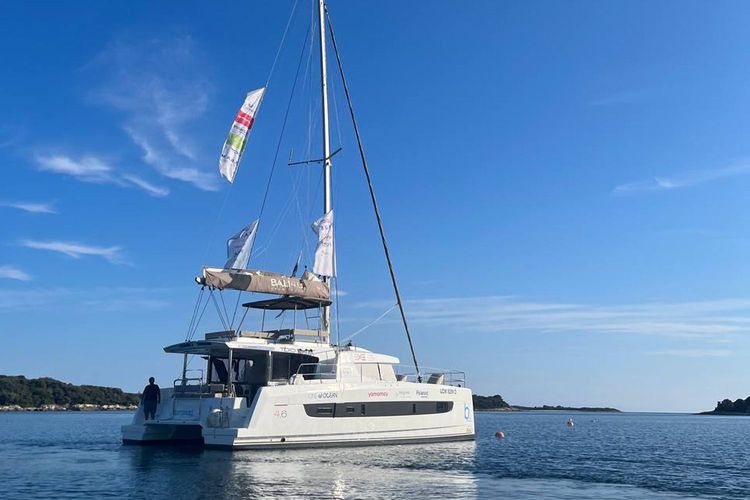
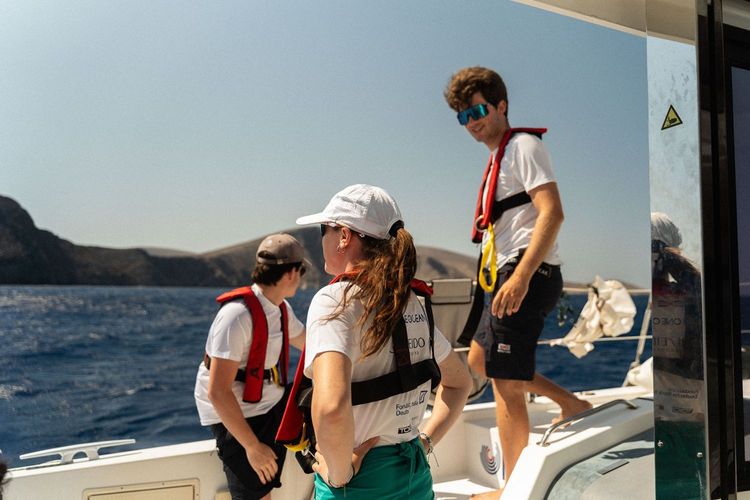
The research, published in Marine Pollution Bulletin, was carried out during the fourth expedition of the M.A.R.E. – Marine Adventure for Education and Research project, promoted by Fondazione Centro Velico Caprera ETS in collaboration with One Ocean Foundation. The study was coordinated by Ginevra Boldrocchi, researcher at the University of Insubria and Scientific Coordinator at One Ocean Foundation.
What Zooplankton Can Tell Us About Pollution
Between May and July 2025, the expedition covered approximately 1,950 nautical miles, crossing the Ionian Sea, the Aegean Sea and the central Mediterranean. During the journey, researchers collected 26 zooplankton samples to measure concentrations of PCBs and DDT.
The pattern that emerged points to a strong relationship between land-based pressures and marine pollution. While the study cannot conclusively link contamination to specific sources, offshore areas generally showed substantially lower contamination levels than coastal waters.
The findings also highlight the value of zooplankton as a bioindicator of marine pollution. As a key component at the base of marine food webs, zooplankton can provide valuable insights into the presence and distribution of contaminants, as well as how these substances may enter and move through the food web.
PCBs
The highest PCB concentrations were generally found in coastal areas exposed to greater industrial and urban pressures.
The highest value, 96.5 ng/g, was recorded in the Athens and Saronic Gulf area, followed by Rhodes, Taranto and the eastern coast of Sicily. The concentrations detected in these areas are consistent with significant anthropogenic pressures and their industrial history. However, the data do not allow individual contamination sources to be identified with certainty.
DDT
Quantifiable concentrations of DDT were detected in 54.5% of the samples. The predominance of DDE and DDD — degradation products of DDT — points to the largely historical nature of the contamination and highlights the long-term persistence of chemicals that were widely used in the past.
The highest concentrations were recorded along Greece’s western Ionian coast, particularly near Zakynthos (20.4 ng/g) and in the Gulf of Kyparissia (12.4 ng/g).
How Does the Central and Southern Mediterranean Compare?
The results become particularly significant when compared with previous studies of zooplankton from other Mediterranean sub-basins, including the Tyrrhenian Sea, the Western Mediterranean and the Adriatic Sea. For both contaminants, the Tyrrhenian Sea recorded the highest average concentrations.
For PCBs, the average concentration was 45.0 ng/g in the Tyrrhenian Sea, compared with 34.0 ng/g in the Western Mediterranean, 28.1 ng/g in the Adriatic Sea and 11.4 ng/g in the central and southern Mediterranean surveyed during the 2025 M.A.R.E. expedition.
A similar pattern was observed for DDT: average concentrations were 8.9 ng/g in the Tyrrhenian Sea, 5.1 ng/g in the Western Mediterranean, 3.1 ng/g in the Adriatic Sea and 3.3 ng/g in the central and southern Mediterranean.
By providing the first assessment of PCB and DDT contamination in zooplankton across this part of the Mediterranean, the study fills an important gap in our understanding of the region’s marine environment. It also establishes a valuable baseline against which future changes in persistent organic pollutant levels can be assessed.
The findings further demonstrate the value of combining chemical monitoring with complementary approaches to understanding marine ecosystems, including biodiversity tools such as environmental DNA (eDNA).